The direct care staff-to-resident ratio should ideally be 1:5 to 1:8 during day shifts and no more than 1:15 during night shifts. These specific metrics ensure that every resident receives timely medical intervention, assistance with daily living, and rapid emergency response, which are the primary benchmarks for safety in a long-term care environment.
Selecting a facility for a loved one requires looking past the lobby aesthetics to find the clinical heart of the operation. Whether you are researching senior living in Cherry Hill, NJ, or evaluating options in the surrounding suburbs, this checklist helps you vet a facility’s true operational standards during a tour.
1. How is “Direct Care” staffing calculated for each shift?
The most critical question is distinguishing between “total staff” and “direct care staff.” During a recent quality review for a family in Cherry Hill, NJ, we noted that top-tier buildings exclude administrative and kitchen personnel from their care ratios to provide a transparent look at bedside support.
Clinical Staffing Benchmarks
| Shift Type | Optimal Ratio | Industry Average | Red Flag Warning |
| Day Shift | 1:6 | 1:10 | 1:15 or higher |
| Evening Shift | 1:10 | 1:15 | 1:22 or higher |
| Night Shift | 1:15 | 1:25 | 1:40 or higher |
2. What are the specific qualifications of the 24/7 nursing team?
A high-quality care center in Cherry Hill, NJ, must have a Registered Nurse (RN) on-site at all times, not just “on call.” Confirm that the facility employs a dedicated Director of Nursing (DON) to oversee clinical protocols and hospital transfer transitions.
3. How does the facility handle specialized cognitive deficiencies?
For residents with dementia, general nursing isn’t enough. Ask if the staff receives ongoing behavioral health training to manage “sundowning” or wandering without relying on heavy sedation, which is a common differentiator among rehab homes in Cherry Hill.
4. How does the “Sanctuary & Synergy” model impact daily life?
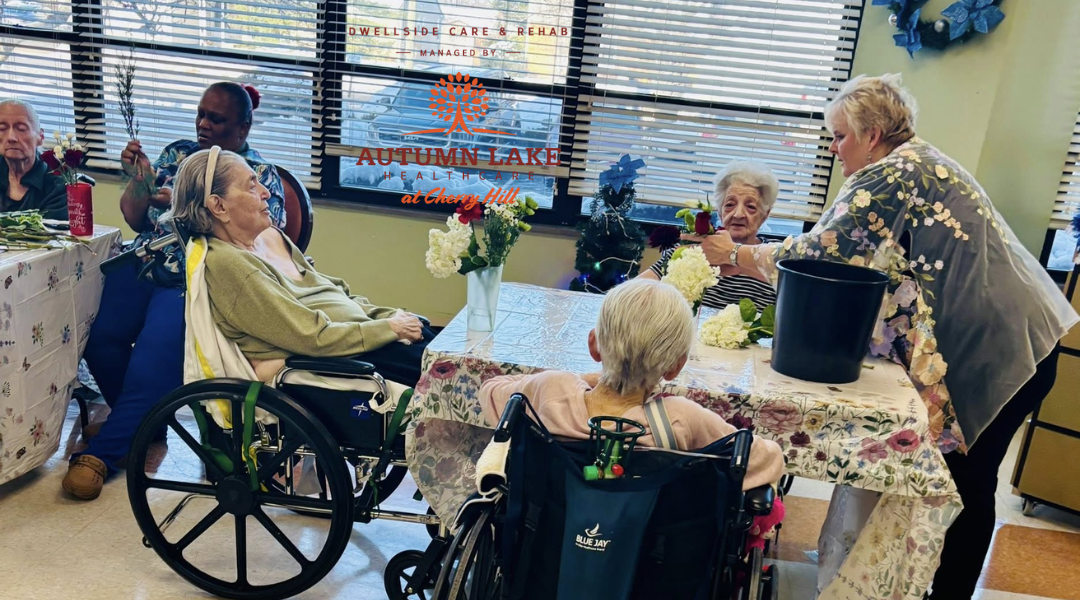
At our facility, we move beyond basic room-and-board to offer a proprietary environment designed to balance clinical excellence with emotional tranquility. This “Sanctuary & Synergy” approach defines our unique care philosophy:
- The Quiet-Scenic Buffer: We offer residents a quiet, scenic environment removed from the bustling city area to reduce sensory overload.
- The Secured Core: A specialized unit featuring an alarm system to aid in the security of residents with cognitive deficiencies.
- Social Architecture: Several large courtyards, a movie theater, and comfortable common areas designed for family events and socializing.
- Around-the-Clock Skilled Nursing: Excellence in long-term care for a wide range of complex medical conditions, including pharmaceutical delivery and on-site hospice rooms.
5. What is the average staff tenure on the specific unit?
Consistency is the backbone of safety. When touring Cherry Hill nursing homes & elder care, ask if the same CNAs are assigned to the same residents daily; continuity of care allows staff to notice subtle changes in a resident’s health before they become emergencies.
6. Can you accommodate specific dietary and dining preferences?
Nutrition is vital for recovery, particularly during short-term rehab in Cherry Hill, NJ. Inquire about the variety of menu selections, the availability of in-room dining, and if there are private dining rooms for family gatherings.
7. What environmental amenities are included in the daily rate?
A facility should support a resident’s dignity through its physical features. Ensure the following are accessible:
- Personalized Space: Individual climate control, private bathrooms, and spacious rooms.
- Connectivity: Wifi, cable television, and a computer with internet access.
- Wellness: A fitness room, on-site beauty salon/barber, and smoke-free gardens.
8. What is the protocol for emergency medical transfers?
Ask for the specific “chain of command” when a resident’s condition changes. A transparent facility will clearly explain how they coordinate with local hospitals and how families are notified during a medical event.
9. Are pets and personal items permitted in the rooms?
To make a facility feel like home, check if pets are permitted and if residents can bring their own furniture. Small personal touches significantly improve the psychological transition to long-term care.
10. Which insurance providers and payment models are accepted?
Financial clarity prevents future stress. Ensure the facility accepts Medicare, Medicaid, and most private insurances, and ask for a clear breakdown of “Private Pay” rates for ancillary services like laundry or the salon.
The “Paper Ratio” Myth: An Industry Misconception
A common industry myth is that a facility’s “Posted Ratio” reflects the staff present on every floor. In reality, some facilities average their staff across the entire building. This means a low-needs wing might be overstaffed while a high-needs medical wing is dangerously short-handed. Always ask for the unit-specific staffing sheet during your tour.
Frequently Asked Questions
What is the difference between an RN and an LPN in a nursing home? RNs (Registered Nurses) handle complex clinical assessments and management, while LPNs (Licensed Practical Nurses) typically focus on medication administration and basic care under RN supervision.
How do I verify a facility’s safety record? You can access the CMS Five-Star Quality Rating System to see audited data on staffing, health inspections, and quality measures.
Is housekeeping and laundry included? In most skilled nursing environments, basic housekeeping and on-site laundry facilities are included in the daily or monthly rate.
To Sum Up
At Dwellside Care and Rehab managed by Autumn Lake Healthcare at Cherry Hill, we invite you to see our clinical excellence in action. Schedule your private tour today to meet our team and explore our scenic courtyards.